Showing posts with label design. Show all posts

13 January 2016

Google Fit app review: a free and excellent fitness tracker

If there's one piece of technology that has really exploded in popularity in recent years, it has to be fitness trackers. As recent as 3 years ago wearing devices around your wrist, clipped to your clothing was a niche market. At the same time, using phone app to track your runs or rides were common for enthusiasts and competitors, but the average person didn't care all that much. Since then however, it's difficult to be in a public place, a shopping centre, office, or busy pedestrian street without spotting many a lot of these devices on people's wrists.

Activity trackers likes Fitbits were among the most popular holiday gifts for the last couple of years. Whether it's dedicated devices or specific apps, it's become incredibly common, extremely easy and debatably useful for people track their steps, weight, distance travelled, energy burned and overall physical activity in pursuit of better health and well being. There are so many options with a wide range of features, form factors and price points, but if you're just starting out and testing the waters, Google Fit may be what you're looking for.
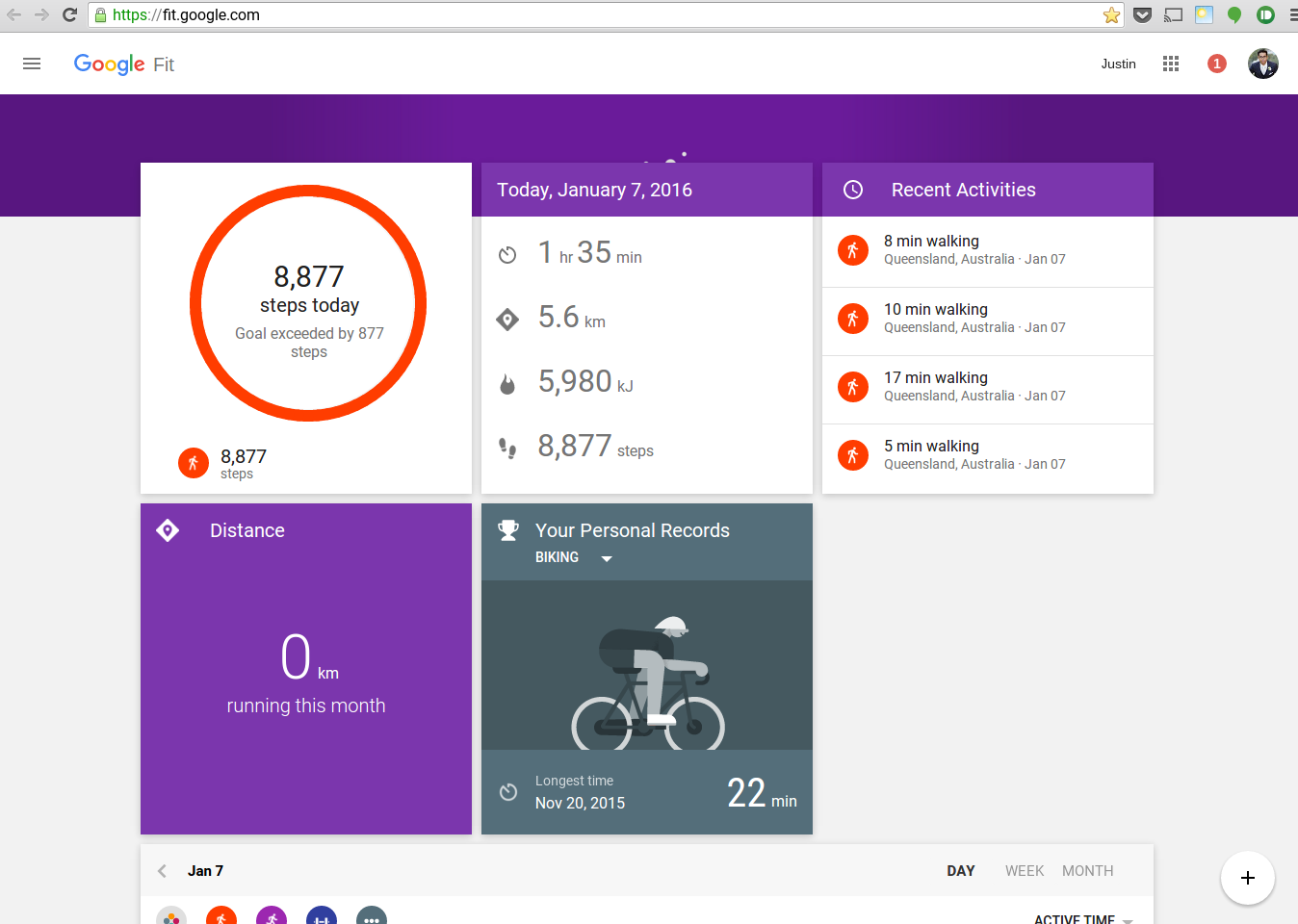

Google Fit is an activity tracker created and managed by Google, in the same vain as Gmail, Google Photos, and Google Calendar. Like all other Google Apps, Google Fit is at its core, web-based which means all information is stored and sorted on Google’s services and therefore accessible across all internet connected devices. Google Fit’s ability to automatically track steps, distance and all other typical use-case information, requires your phone to run Android 4.0 (Ice Cream Sandwich) if the phone itself is going to be the primary tracker. The Android OS version shouldn’t be a worry as over 90% of all Android devices run at least 4.0 - if you have an Android device younger than 5 years, you should be good.

What Google Fit does

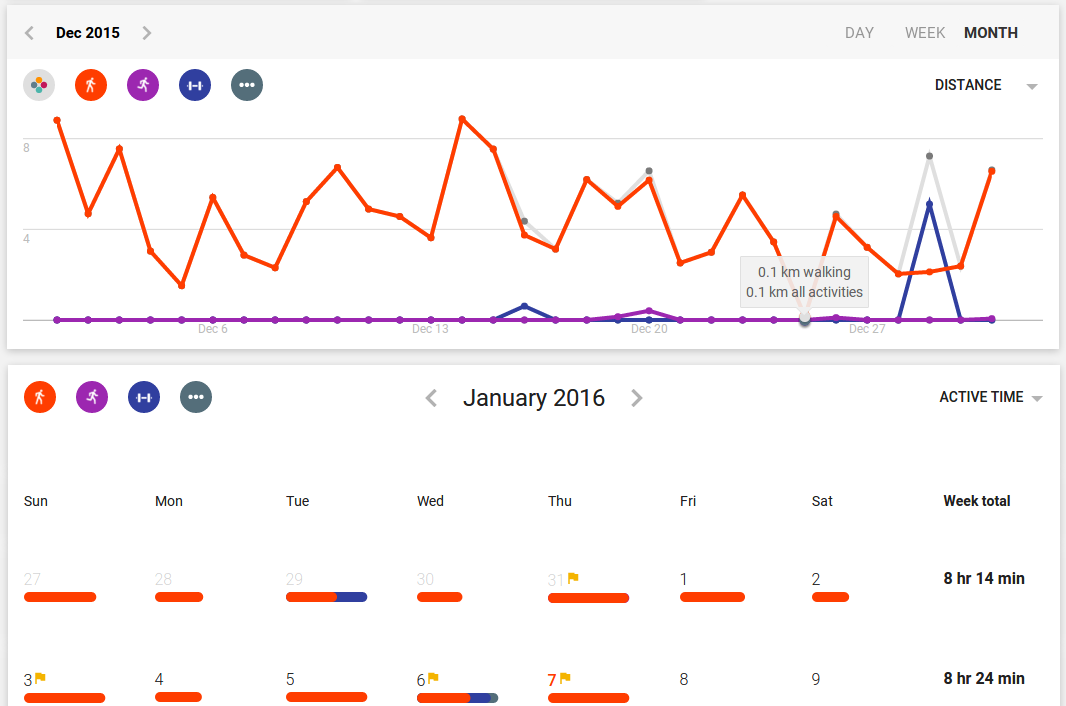
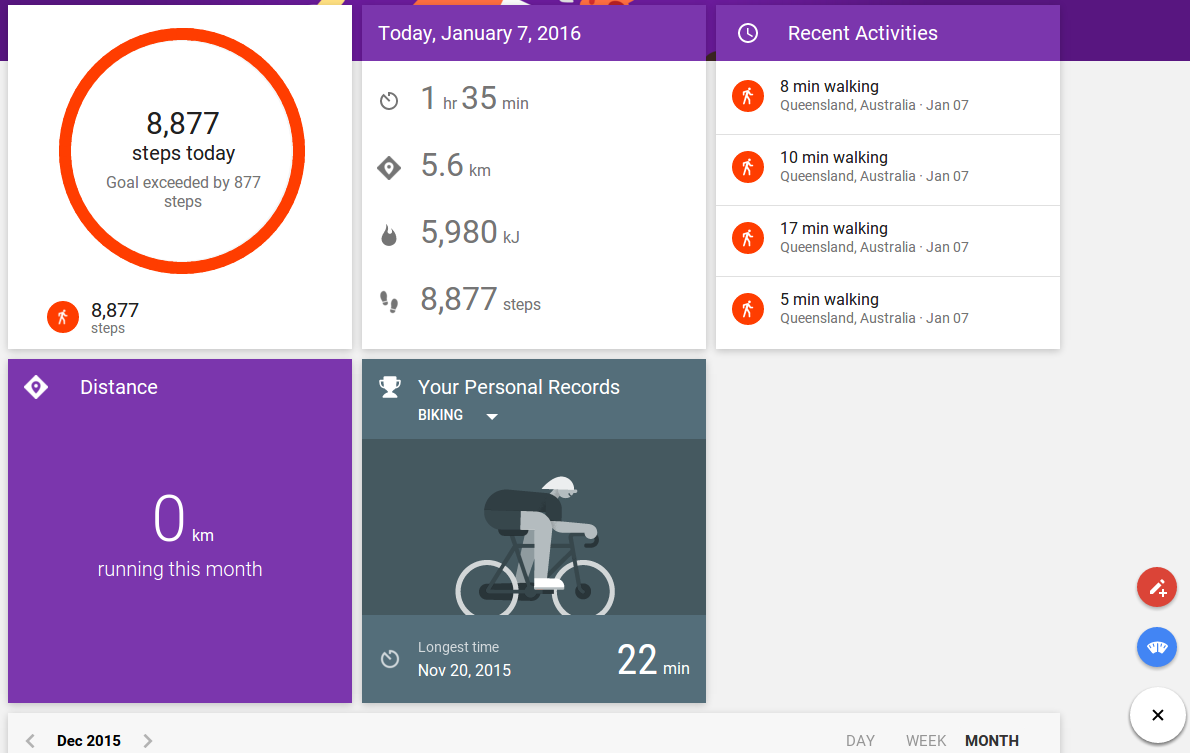
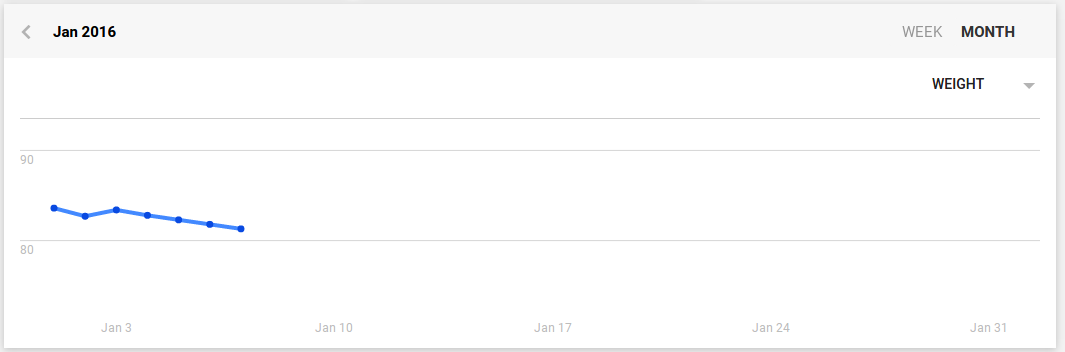
Google Fit is an app which tracks all of the basic markers of physical activity - steps, distance, active time and energy burned. It also allows you enter goals for each on a daily or weekly basis, and enter your weight measurements. The ring is usually the first graphic you see which fills as you build your activity each day with different colours differentiating between different information. The app is able to intelligently distinguish between walking and running, so if you forget to identifying a run, it will still log your steps, energy and the rest as your pace picks up. It's needy, but fun, to go back and find out that it identified those times you quickly scurried across the road or ran around the yard with the dog for a few minutes. Of course, for deliberate workouts, you can select your activity from a massive list (A-Z, Aerobics to Zumba) and the app will smartly configure energy burning, steps and active time for you. You can also enter an activity afterwards - in case you forgot or didn’t have your phone, or any tracking device on you at the time of your workout.
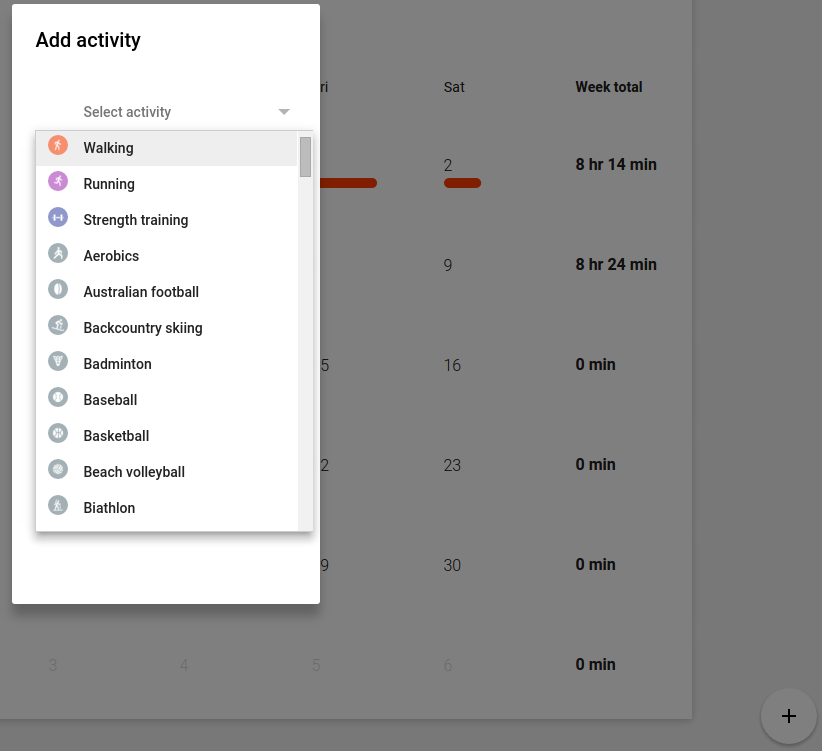

Google Fit then sorts all of this information and presents it to you in real time and with next to no effort. Simple rings and bars show progress, icons are clear and the overall interface make scrolling through past activities, entering new data, changing settings or viewing progress trends easy and fast. The app is designed incredibly cleanly and refrains from bombarding you with menus, options and other elements that could create a cluttered and distracting user experience. Everything you could want to see is incredibly easy to find.

Google Fit is free and available everywhere
The best things about Google Fit are it's price and availability. As alluded to before, like most Google services it is entirely free and accessible anywhere. Download the app to your Android phone, spend 5 seconds activating it and you're good to go. There's no need to turn it on or off when you want to use it, once you're setup it just just keeps working. I am pretty deliberate with tracking my activity, it's fun for me, so I'm always looking at the app on my phone, or on my laptop (fit.google.com) to see how things are going. My wife doesn't care so much, but does like to see from time to time. She remembers her phone does this maybe once a week and very simply she can get a solid idea of how active she's been over the last few days, weeks or months. Of course, this depends on your phone being on you, unless you have a tracker or smart watch.

The availability is where I find the most piece of mind. Apple Health requires an Apple device, there is now Web version, so if you one day move to Android or Windows phone and your history is locked within Apple's walls. As said before, Google Fit being available via a browser adds a greater layer of openness for the long term. It's so handy to be able to look at my activity on my phone, tablet and laptop, and it pulls from most other notable fitness trackers to combine everything in one place is incredible. The value increases exponentially as I'll still be able to do so when I upgrade all of those devices. IT should be noted however that synschornisation isn’t perfect - at least not in real-time. Below is a photo of the web-site screen, my tablet and phone and as you can see the information is close, but not exactly the same. Past results all seem to be consolidated, for example the logs are all identical as of 2 days ago and earlier, but real-time and the day before seem to be be slightly conflicting.
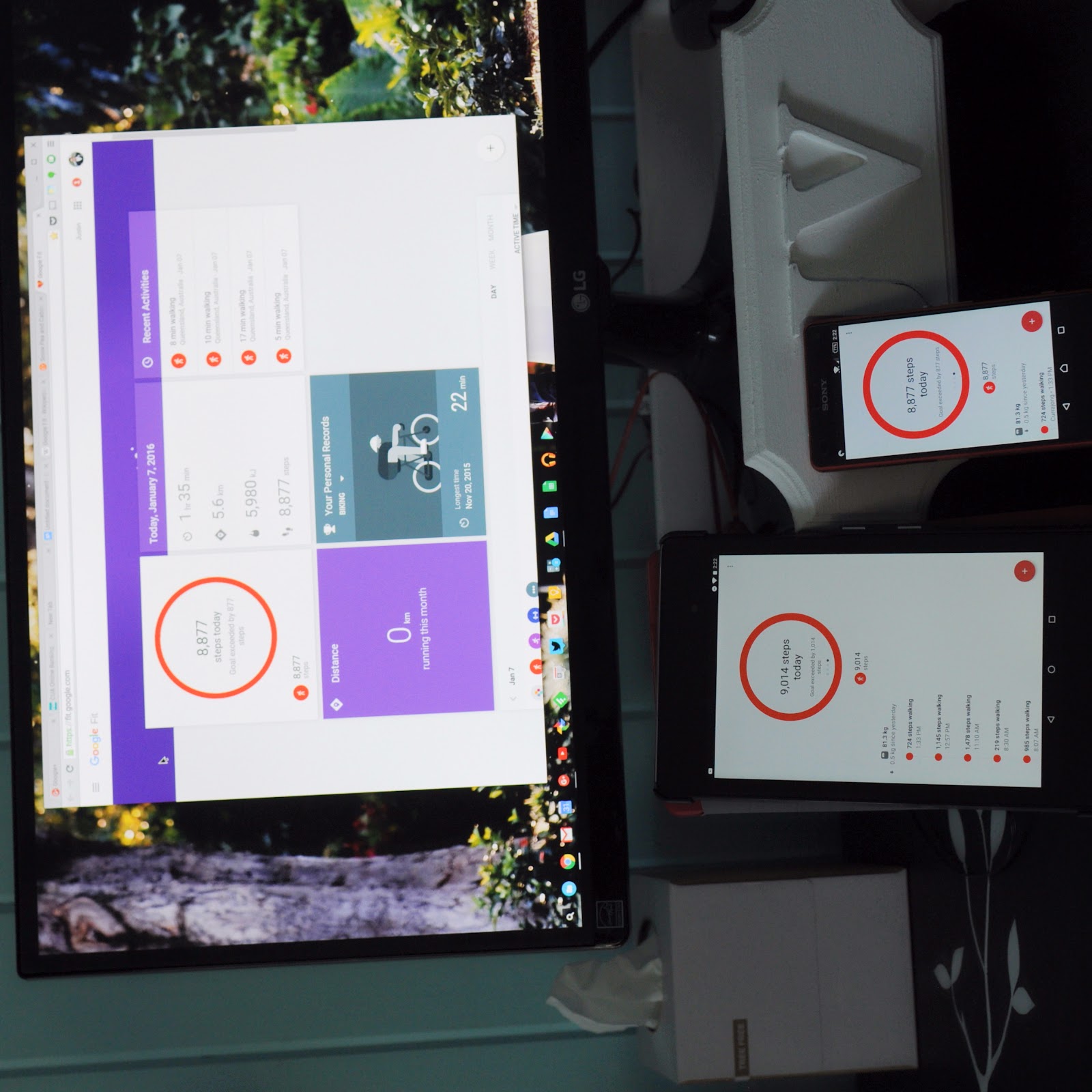

While the slight glitch in across-device consistency isn’t perfect, this flexibility is the greater plus. Maintaining a healthy lifestyle is forever, so if you're in the camp that finds value in activity tracking, being locked into whatever device you're using in a given moment, and the possibility of losing everything if and when you change to something else is a big deal. You may use a step counter now, then take up running next year and therefore want a different device made by a specific running brand like Polar, change phone makers 2 years later, and who knows what else in the decades to follow. It pains me that the biggest line, Fitbit is refusing to partner with Google (or Apple) on this. Fitbits are great, but on a  personal level I don't like services that are built to lock me in.

There's no iOS app yet
The unfortunate and frankly, un-Google aspect is that there currently is not iOS app. The Google Fit app is exclusive to Android, just like Apple’s version, HealthKit is exclusive to iOS. This means that iPhone users can use Google Fit to keep their records, but the phone’s sensors can’t feed into Google Fit directly. That being said, Google has allowed access to developers for anyone who chooses to use their APIs, which means that most of the well known fitness apps, Nike, Strava, Adidas, Withings, Runtastic, RunKeeper, and MapMyFitness can all synch to Google Fit. So, if you use Strava to track your bike rides, Nike+ to track your runs, plus want a place to log your weight each week, Google Fit can be your one-stop-shop. It is bothersome that Google Fit is not available on iOS. Google Apps are usually written for Apple devices (Gmail, Drive, Google Maps, Google Play Music and Google Photos are all on iOS), as Google’s model is built on allowing everyone to use their services, so Google Fit may be coming. Long story short, if you have an Android device, you’re all set, if not, you’ll need a fitness tracker otherwise you’ll be entering things manually.

Overall
Google Fit is a free application for logging and tracking your physical activity and workouts. There’s no iOS app yet, but you can still access the app via the website which is a very big advantage. This, plus the fact that it can link to almost all other fitness tracking devices (i.e., Withings, Runtastic, Strava, Nike+, RunKeeper, etc) means that your activity will stay with you regardless of what watch, phone, wristband, tablet or laptop you find yourself using as the years go on. And, given that maintaining an active and healthy lifestyle isn’t a temporary endeavour, the ability to keep tracking your workouts, if you find so beneficial, regardless of what watch, phone or wristband you’re using is incredible.

The link to the website is fit.google.com and you can find the


16 December 2014

The Nexus 4 Review - The Best Budget Phone for 2014

Budget smartphones have been getting a lot of attention these days. In general, it can be argued that the market for flagships has stagnated. There’s an overall lack of enthusiasm with new top-of-the-line phones upon unveiling within the tech world. It seems that over the last year or so, it’s become more difficult and therefore less likely, for manufacturers to bring brand new, innovative features that really impress people. Whether it’s the newest iterations from Apple, Samsung, HTC, Google, or any other major player, the improvements over previous models are smaller and incremental rather than truly revolutionary. Thinner, lighter, faster, sharper display, better camera, etc.

Screenshot 2014-12-15 at 2.38.07 PM.png
It's a pretty popular Google search
This may be why more attention is on wearables, smart homes, integration across devices, and the afformentioned value-for-money smartphone. This is also why, if you subscribe to any of the top tech news or review sources, you’ll find plenty of great advice on the “best smartphone if you’re on a budget”. Here are some pieces that inspired this article.


If you’ve been looking into buying a new phone as well, but aren’t interested in shelling out the better half of $1000, you’ve probably read a lot about many different phones, but odds are, most of the spotlight has been on the Moto G. It’s not the cheapest, or the best, but the consensus is that it strikes the perfect balance between today’s smartphone consumer demands, and an affordable price tag. The problem is, there’s one phone that has almost no attention at all in terms of budget smart phones and it should. It’s cheaper than the Moto G, has a better screen, more premium feeling design language, same amount of ram and generally, the same overall power under the hood. This phone, the real best budget phone, is the Nexus 4.

DSC_4682.JPG
Over 2 years old and received the OTA
This is not to say that the Moto G doesn’t deserve all of the praise it’s received this year. It’s a great phone. Building upon last year’s model, it’s the affordable smartphone that hits all the right points for those that want a solid phone that can handle all of today’s typical needs - apps, photos, games, media and mobile browsing, but without the top-tier features and latest specs that come with the high price tags of flagships. It’s capable of 4G has a sharp display, is well designed with a decent camera and runs fairly smooth. The “runs fairly smooth” part has always been the big compromise with budget phones. Spending less than $500 on a phone usually meant stuttery software with plenty of bugs that really wasn’t capable of much and therefore not really fun to use. The Moto G is really one of the first affordable smartphones to turn those traits on their heads. Motorola designed a low-spec device, making it wallet-friendly, but focusing on simplicity rather than features, ensuring Android runs as smooth as possible.

This is why I’ve spent the last few months eagerly awaiting the Moto G’s 2014 release. I’ve been a proud Nexus 4 owner since launch back in 2012, and since it’s been over 2 years, my instincts has told me it’s time to get something new. So like any smart shopper, tech enthusiast, or big nerd would do, I started comparing specs, and came to a very surprising realisation. Upgrading from the Nexus 4 to the 2014 Moto G wouldn’t be a very logical move. Despite the 2 year age difference, I found out that these two phones are incredibly similar in capability. Even further, many aspects of the Nexus 4 are objectively higher-end than those of the Moto G. As strange as it may seem, given that the Nexus 4 was never a best-in-class phone, even when it was brand new, the reality is that it is quite easy to argue that the Nexus 4 is better than the Moto G.

The design of the Nexus 4 remains as one of the most unique designs any smartphone has every had. The glass back was nothing new at the time,the iPhone 4 was the first major release to do that. Glass backs have also been done since, most notably by the Sony Xperia Z series. However, the reflective, checkered pattern beneath the glass back gave the Nexus 4 a distinct visual marker without being too gaudy. In the right light the phone sparkled, otherwise, it was a very understated black glass panel with silver “nexus” branding. I have a dBrand skin on mine, so it’s a moot point in terms of visuals, but there’s still a rigidity to the phone which may mean more in terms of design and build quality.

DSC_4681.JPG
+dbrand skins are the best
In a time where “lighter and thinner” seems to be the mark of innovation, the Nexus 4 has a solid feel and heft that, may have been light at its launch, but now, makes the phone feel unusually strong - even if only, artificially. It feels like an expensive, well designed device, despite being offered at an affordable price point. A dBrand skin solved the concern regarding slippery fracture prone backing, creating in my opinion the only nexus phone that has hit the “premium” mark in terms of fit and finish.

As far as software is concerned, Android 5.0 Lollipop is running fantastically on my phone. The phone is faster, the animations run smooth, and I honestly haven’t had an issue with lag. Really, there’s not much point into going over the software too much. There are plenty of Android Lollipop overviews out there. All that’s important here, is that, at least on my Nexus 4, it runs great and has definitely made the phone better.

DSC_4680.JPG
100% stock. with Google Now Launcher
Despite my praise for the Nexus 4, the fact remains that I was pretty close to upgrading it and the main reason for this was the camera. It’s no secret that Nexus phones don’t have great camera’s and this phone is one of the reasons that reputation exists. The camera upon launch was pretty good, but it’s definitely nothing in comparison to modern flagships. It’s not a bad camera, but it’s not a camera you’re going to trust either. Every time I take a photo, I large part of me is prepared to be unsatisfied by it. This for me has always been the biggest cost-cutting measure which allowed these phones to be priced so competitively.

DSC_4678.JPG
The camera's not the best
The other reason I was looking to replace my phone was the release of Android 5.0. I was mentally prepared for the Nexus 4 to not receive an update sicne it’s been over 2 years. Still, I wanted to see if it would receive the the update, and if so, how it handled it. To my surprise, the OTA game through in about a week after reports that Nexus 5s started receiving theirs and even before Nexus 6’s started shipping here (Australia). As I said before, there’s absolutely no problems with it. Lollipop is runnign fantastically on my unrooted, completely stock Australian Nexus 4.

A little while ago I took a poll to the Google+ Nexus Community asking which phones people would rather buy. As expected, the majority sided with the Moto G. Interestingly however, was the margin. 40% voted for the Nexus 4. Despite being 10% under even, this is still impressive considering the phone is over 2 years old. I doubt this would be much worse than the results would fair if it were the Nexus 5 were up against the Moto G. Further, I think it’s a safe assumption that if it were the even older Galaxy Nexus it may be pretty close to 0%.

40% voting for an out of production, 2 year old phone
Of course, the Moto G, just a few months into it’s life cycle is understandably more current and future-proofed than the Nexus 4 which is over 2 years old. Where the Moto G is likely to be supported for at least another year, I wouldn’t be surprised if 5.0 is the last update the Nexus 4 receives. Battery life is reportedly much better as well, despite the slighlty smaller battery. Design is subjective, I prefer my phone to sit flat on a table, so the curved Moto G would bother me a fair bit. It’s also subjective, but I don’t like the idea of having a phone any larger than the Nexus 4. I am a runner, and the idea of carrying something larger bothers me as well. This is the main reason I wouldn’t get a Nexus 5 - that and the protruding camera. I do like the front facing speakers however. I hope that more manufacturers jump on board with that.

DSC_4677.JPG
This shot has me thinking it's the perfect size. 
The reality is that the Moto G and the Nexus 4 are very comparible devices. This is what was most astonishing and frankly, advocates the most for the quality of the Nexus 4. It was released over 2 years ago and for around half the price of the other 2012 flagships. Today in 2014, a phone arguably equal in power and capability is the almost unanimously regarded as the best value-for-money smartphone there is - despite being more expensive A quick scan of typical online retailers shows the 8 GB Moto G and the 16gb Nexus 4 are pretty similar in price. Although, a phone which has likely been out of production for over a year, being “brand new” may be a bit understandably questionable. So, despite the urge to get a shiny new phone (I bought the Toshiba Chromebook 2 instead), I decided to hold off and ready myself to leave the Nexus line behind and get the Sony Z3 Compact. I want a good camera.

DSC_4675.JPG

24 November 2014

Brooks PureGrit 3 Shoe Review

DSC_4610.JPG


Over the last few years there seems to have developed a dichotomy within running shoes. There are traditionals and minimalists. Without getting too much into the debate, there are generally two, sometimes awkwardly heated, schools of thought. Those in favour of minimalist shoes believe in the the promotion of the more natural and efficient running form that being barefoot would promote. Lines like the New Balance Minimus and the cultist Vibram Fivefingers, encourage proper form by forcing more mid-forefoot striking and by allowing greater flex and movement. Running barefoot is thought to be the best way to learn how to run properly and thus move smoother, faster and with less injuries.

Screenshot 2014-11-24 at 8.12.16 PM.png
Traditional running shoes, such as the Asics Kayano or Brooks Adrenaline ranges, are founded upon reducing shock and stabilising the foot in optimal positions. While flexibility and reducing weight iare important factors, the reality is that all of the foams, glues, fabrics, rubbers and plastics make traditional shoes heavier, stiffer and, generally more cumbersome for runners. Another main aspect of traditionals is the large drop, which is the difference in thickness of the midsole from heel to toe. Generally, the midsole under the heel is much thicker than that of the toe - usually 10-14mm thicker, to allow for minimal shock when the heel strikes the ground. Of course, without the plush padding and support that traditional shoes offer, there’s a lot more impact on the feet, bones and joints. Reality is that for those that are overweight, or are unable to (learn how to) run with proper form, minimalist shoes can lead to a lot of damage and pain.

Screenshot 2014-11-22 at 8.35.37 PM.png
So, again, the Pure project addresses this by finding an optimal balance between the two by being softer and more supporting than true barefoot runners, but lighter, more flexible and with a lower drop, allowing for a more natural foot strike than the traditional. The Pure Project consists of several models, depending on where you are on the minimalist scale. Starting at the “barely there” side is the PureDrift, the lightest, most flexible of the bunch. At the other end is my favourite running shoe for the last 2 years is the PureCadence, these fill all the criteria for a minimalist shoe (light, flexible, low drop) but still with a good amount of cushioning and support. The idea is that anything beyond this is a traditional Brooks runner. Then, there’s the PureGrit. Another Pure Project entry, but tailored for those that love the harsh, uneven, rocky, dirty and potentially wet trails. I’ve had them for about a month now and after a about 30 kms worth of off-road workouts, here’s how they’ve been going. This is my review of the Brooks PureGrit 3s.

DSC_4582.JPG

Key Features
  1. BioMogo DNA midsole providing adaptive cushioning
  2. 4mm heel-toe drop to encourage midfoot striking and proper form
  3. Ideal Heel, rounded heel cradle for better alignment and transition
  4. Ballistic Rock Shield protecting feet from trail hazards
  5. Nav-band to wrap midfoot securely
  6. Aggressive 3D Hex lugs for maximum tread
  7. Weighs 280 grams (9.9 ounces)
  8. Suited for neutral pronators with medium to high arches

Test Conditions
  • About 4 separate sessions in a month ranging from 4 to 8 km
  • Rocks, timber steps, dirt road, bouldered trails
  • 100m elevation change per km
  • Grass running track for mile test
  • Very dry and dusty, no mud or wet work.
  • 2 years and over 1000km in the Brooks PureCadence

The first thing I noticed about the PureGrits were how much more solid and less plush they feel compared to the PureCadence. The lugs under the very rugged outsole are noticeable upon first wear -- at least for someone who hasn’t worn a trailrunner before. There is also a Rock Shield under the forefoot, which is new to these 3rd editions. The aggressive outsole, hexl lugs and Rock Shield make for an incredibly solid and convincingly protective feeling shoe. They hold up very well up on the trails. My local routes involve steep, rocky climbs combined with timber or demolished boulder steps. On impact I could feel enough to establish a sure footing with solid traction, but still was able to maintain a smooth ride with minimal shock.

IMG_20141122_073629.jpg

One thing that I noticed wasn’t as prominent relative to the PureCadence was the heel-toe drop. Although it’s listed as a 4mm drop, the “Ideal Heel” contour isn’t as dramatic as the PureCadence, which means that the compared to the Cadence, the Grits have my heels sitting noticeably higher than my forefoot. I’m not sure if this is objectively good or bad, but I definitely feel more inclined to strike more forward in my foot in the Cadence than in the Grits. On flatter terrain, I have to be a bit more conscious not to heel-strike than I would like. That being said, there’s still plenty of that springy nature because of the encouraged midfoot landing that minimal running shoes are known for.

DSC_4581.JPG
Speaking of bounce,  BioMogo midsole remains as a very substantial, yet middle of the range cushioning system. They’re soft, but not too soft, and focus mostly on absorbing impact and offering a smooth ride rather than being plush or bouncy. It always comes down to personal fit, but I have always scored Nike’s Zoom or Lunar systems (i.e., Pegasus, Structure, Lunargildes, etc) as too soft or bouncy to the point of feeling as my feet were wobbling on impact. BioMogo was always a bit firmer than these, but not nearly as firm as Mizuno’s Wave (i.e., Rider).
IMG_20141122_071617.jpg
Of course, when talking about trail shoes, tread is an important factor. The 3D hex lugs, are very aggressive, though are not cut sharply like most trail treads are. Their shape is symmetrical in all directions (hexagonal) which means they do not seem to be geared toward any specific direction - forward in particular. The rubber is also very tactile indicate excellent grip. The result is a very confident landing on trails, as the lugs dig into any surface securely and with good balance. However, compared to the more traditional teeth-like treads on other runners, these don’t necessarily grab the trail and launch you forward. Perhaps this is another deliberate move to encourage proper form and more natural movement.

DSC_4580.JPG

The upper scores well in terms of fit. I haven’t experienced any friction hot spots, and foot feels very securely wrapped and helps within the show and above the midsole as it should. Ventilation is excellent as well. I was weary of how the bottom of my feet would feel. I live in a very hot, dry-tropical climate so heat is a big concerned. This morning’s 90 minute session was in 33C or 90F, which made for a pretty exhausting hill climb, but I’m happy to say that neither breathability, moisture or temperature posed problems. I’m not entirely sold on the Nav-band however. I’m skeptical of how much a one inch strip of elastic can help lock things in place, and with the PureGrits, the band is a bit too long and bunches when I lace up. Still, the upper fits very comfortably, at worst, this band may be inaffectual.


There is one issue with the upper which I consider more significant, and that is the tongue stitching. The majority of running shoes structure the tongue of the shoe with either a centre-loop on the centre for the crossing of laces to fit through, or have the sides of the tongue attached to the upper. The purpose of either of these is to ensure the tongue stays where it should, above the centre of the foot. The PureGrit3’s don’t have this. The tongue is only attached at its base which means that it’s rather easy for the tongue to slip down to either side of the foot and shoe. For me, they slip to the lateral sides. It doesn’t seem to happen often so it’s not that big of a deal. But once or twice on each of my runs I had to stop to pull the tongue up. It’s not a major drama as it doesn’t cause pain of any kind, the materials are so soft that the foot stays securely and snugly wrapped. It doesn’t cause any pain or anything, It’s just really annoying.

IMG_20141119_173022.jpg

One of the reasons I’ve gone so long without giving trail running a go is because I haven’t been able to find a shoe I felt comfortable with. I have always had a hard time purchasing runners that would only really be useful for the trails, and then still needing a road pair. Traditional runners have always felt too heavy, firm or stiff to make for a good road run. I never liked the idea of having shoes for trails and different shoes for roads. I’m not a competitor - I love running because of how simple it is and  how little is needed. That being said, taking the leap with a trail shoe from the Pure Project left me pleasantly surprised. I’m confident in these not just as a trail shoe, but as a road runner as well. They’re light enough and soft enough for the roads but strong enough for the woods.

At the end of the day, the PureGrit 3s make an excellent trail runner - minimalist or otherwise. In fact I would recommend these as an all-purpose general training runner rather than just for off-road trekking. They’re light enough. soft enough and offer plenty of support for road sessions, with the added bonus of protection and traction for harsh terrains full of dirt, rocks, mud and hills. If you’re in the market for one shoe that are smooth and fast enough for the roads but rugged enough for the rocks, the PureGrit 3s might be just what you’re looking for.

PANO_20141119_172031.jpg

25 September 2014

Holiday Housework - Painting and Gardening


This week I started a couple weeks of holidays, and with all breaks, the priority is house work. Job number one was to repaint our front steps since as you can see, they finishing needs a fair bit of work. We were never after a big renovation, we just needed a bit of weatherproofing. The months from January to March are about as heavy as anywhere in the world in terms of rainfall. The steps were freshly painted when we moved in a year ago, and we didn't like the idea of hoping they would hold up after what has happened to them after just one year.


Cleaning, scraping and sanding the stairs took around 3 hours of my Sunday. This was my first time painting anything on the exterior so I am not entirely sure if I picked off enough paint. I didn't really feel like spending money on a power sander, so I did everything by hand. I am generally content with how much effort I was putting into everything. I made sure everything was smooth to the touch and splintering was reduced as much as possible. The first coat went on on Monday and the second coat on Tuesday. It's Thursday as write this and we've just started walking on it a few hours ago. It rained a little bit the other day so the fingers are crossed it dried properly.


On a bit of impulse, we walked into the store planning on just going with the basic dark brown, we figured, now is the perfect time to experiment with some of our colour ideas. If it works well, great, but if not, there was a good chance the stairs would eventually get scrapped within a few years anyway. We went with Colorbond Ironstone (Chip no T147) by Cabot's Timbercolour. The shop worker recommended it as the most durable and easiest to work with. I don't have anything to compare it to other than the British Paints we used to paint our bathroom white.


I'm not an expert when it comes to house painting but I do have some experience. I've done interior drywall a few times painting my room as a kid, and I've painted the aforementioned bathroom. This being said, I don't know how to apply painter's tape. I always end up having to retouch. 


After two coats, we're more than happy with how it looks. We'll see how it holds up after this summer (we average over 1000mm of rain from Nov to Feb with 35C temperatures), but as it stands we really like it. Although I read and watched a lot of how-to's, this article in +SFGate  by +Kristy Robinson seemed to be the one I referred to the most.

We plan on making some major renovations and extensions to the house over the next 5 years so there's a good chance the steps could get scrapped, or at least redone sometime in that term. In any case, I was looking forward to this as an opportunity learn a little bit about exterior timber restoration. We're still in the drawing stages, but I'm sure a deck will be part the aforementioned renovations.


Tending to the garden was second on the list of priorities. Having these two projects to focus on in tandem worked quite well. You wouldn't tell from the photo, but I really like gardening. I am really enjoying revitalising our yard, which was in fairly bad shape when we moved in. There's a lot of laborious work in lawn repair (turfing, weeding, levelling, etc.) so we made sure to have one aesthetically pleasing garden to care for in the meantime.


After turning over the soil and pulling the weeds we moved the bulbs to the edges and planted a few begonia, ixora and hibiscus bushes. I am hoping we are not foolish for not laying down weedmat or spraying any sort of weed killer. Some have told us it's a necessity, others have assured us they've never used it. Live and learn. In terms of design, a less organised arrangement seems to work best with the vibe of our yard. Also, it's easier. It seems a little bare, but I'm counting on the shrubs to fill out. One thing's for certain, I love the smell and look of  the tea tree mulch the nursery recommended. We shall see.

One year into owning our fixer-upper and I'm learning that really the only way to learn is by trying and hoping for the best. We're loving chipping away at all of the jobs this old house keeps presenting to us. It's the end of day 6 and the two main tasks are complete. I still have 12 days left to my holiday, and although nothing is planned, I'm sure the house will give me something to do. Abraham Maslow said, "if the only tool you have is a hammer, (it is tempting to) treat everything as if it were a nail". I'm sure the law of the instrument still applies with a paint brush.