Showing posts with label productivity. Show all posts

04 December 2015

The value in research


For the last few days I've been having a pretty interesting conversation about the benefits of grass fed vs conventionally produced meat on Google+. Where it started off as a bit of a typical confusion fueled internet fight, it evolved into some pretty on-point commentary on the value of academic research. Here is the conversation in full, anonymous of course:

Person A: i want to see the evidence that organic or grass is actually better. Every paper out there says otherwise. You are paying double the price for the product that is marginally better. Common sense applies

Person B: Really? I have read plenty that suggests grass fed and local is best.

Person A: where. Please provide a link to to research paper or nutritional analysis 

Person B: http://journals.cambridge.org/action/displayAbstract?fromPage=online&aid=777732

Person A: sorry this evidence is stronger
http://ajcn.nutrition.org/content/90/3/680.full
http://ajcn.nutrition.org/content/92/1/203.full

Person B: If you believe some studies more than others, that's fine. That's your prerogative. Thankfully, it's not my job to convince you of anything. I just wanted to show you that there is research, because you said you hadn't seen any. You disagreeing with the research isn't the same as there not being any research. 

Person A: OMG dude that meta analysis. it combines all the studies out there. You clearly have no idea about hierarchy of evidence

Person B: You make judgements really quickly. 

Person A: why shouldnt I. If i give you a meta analysis and you dispute that based on your study why shouldnt i judge you. Its you who believes in "suitable" evidence not me

Person B: haven't even told you my opinion. I haven't said anything here about whether I think organic or grass fed meat is healthier.

You said you haven't seen any research that says it is. I said there is plenty of research. You asked me to give you a link. I did.

That's really all there is to this.

Person A: read through this correctly:

Me:  
i want to see the evidence that organic or grass is actually better.
You: Really? I have read plenty that suggests grass fed and local is best.
Me: where. Please provide a link to to research paper or nutritional analysis 
You: give a single research paper based on pregnant animals and from a country where environmental factors are different.
Me: provide 2 spearate links to meta analysis (combined 200+ papers) showing clear evidence that there is no difference or that organic is better.
You: If you believe some studies more than others, that's fine. That's your prerogative.

Who is making judgements here? I believe in strongest evidence available you believe in "selective" and convenient evidence. Simple as that


Person B: The way I see it., you've made more of a judgement than I have. All I did was post one research article, and I only did that because you asked someone to. Had I known that doing so was going to lead to someone implying I don't understand scientific research, or know how to read, I probably wouldnt have bothered.


Person A: your response was biased. Based on one article that suited you.
I've given you a top of the range evidence showing no difference between organic and normal. Which is what I've indicated at the very beginning.
In medicine/science you cannot use whatever suits you. It has to be in best available evidence which your example wasn't.
This is how most of the articles in this community are posted based on preference and not evidence 

Person B: I'm sorry man. I really don't want to have a debate about anything. That was never my intention.

I misinterpreted your original post as a question. I genuinely thought you meant that you hadn't seen any research that suggested grass fed or organic meat was better. This is why I responded with an article, which admittedly was the first one that came up when I googled "benefits of grass fed beef". 

I didn't and don't even care enough at the moment to use some of the research I'm familiar with. I just wanted to show you there was some research because I thought you were saying there wasn't any. 

Had I known that you actually meant "can someone convince me that my stance is wrong? I come prepared with a lot of legitimate research ready for a debate," I honestly, wouldn't have responded. 

Person A: Google plus was created so that people can have debate.
I suppose be both are at fault here. Each of use have different definition of evidence. I knew there is top of the line evidence that supports my claim and anything else would have less "kick".
So unless there is meta analysis /systematic review that shows that organic food is better there is nothing that will be able to convince me or change the way I practice dietetics and give advice to people.
Please feel free to continue this discussion, it doesn't matter who is wrong. At the end ee both will learn something :) 

Person B: Sure we can talk. FIrst I may as well say explicitly now that I think there are defintie benefits in grass fed animal products. This extends to local and wild caught. 

Organic, I am not necessarily sure about but only because the other indicators I think out weigh it. Overall, I tend to believe (and the research seems to support), that finding a butcher you trust, with meat products that come from close by, where animals are free to roam and fed healthy diets themselves, trumps something that is organically produced that may have spent 3 weeks frozen on a truck, boat or plane. 

Another thing is the value in research. Meta analyses are great, but they still have only their place in academia. They serve a great purpose in summarizing and contextualizing existing research, but they don't add anything new to the discussion. 

Especially given the innoation and cutting edge findigns that science pursues, you also need to track newer studies that use new ways of testing and new experiments. 

Meta analysis also doesn't involve any specific new tests. The two you posted specially, were actually really vague. They literally just summarised a bunch of existing papers. They were essentially a survey of existing research. 

And in doing so, their criteria was "health outcomes" which is a bit vague. They reference this themselves. Rather than looking at more specific health effects, they looked at overall trends such as number of people with dimentia or heat disease. 

For example, research that specifically looks at how grass fed vs conventional beef impacted a cognitive functioning, is far more focused of a test - and is actually too specific for meta analyses. 

I'm not saying that those studies aren't valid, but they're not everything. And shouldn't be taken as the "most" valid. They have their place and that's it. 

http://www.ncbi.nlm.nih.gov/pmc/articles/PMC2846864/

Here's something that you may find interesting. It's part literature review, and part dedicated experiment. They looked at how grass fed vs conventional meat affected the lipid profile (good vs bad fats). 

Too narrow in focus to be counted in a meta analysis, but very significant in research as it provides very convincing evidence that grass fed meat proved healthier ratios of omega 3s and omega 6s than conventional meat products. 

The internet is bizarre.

11 October 2015

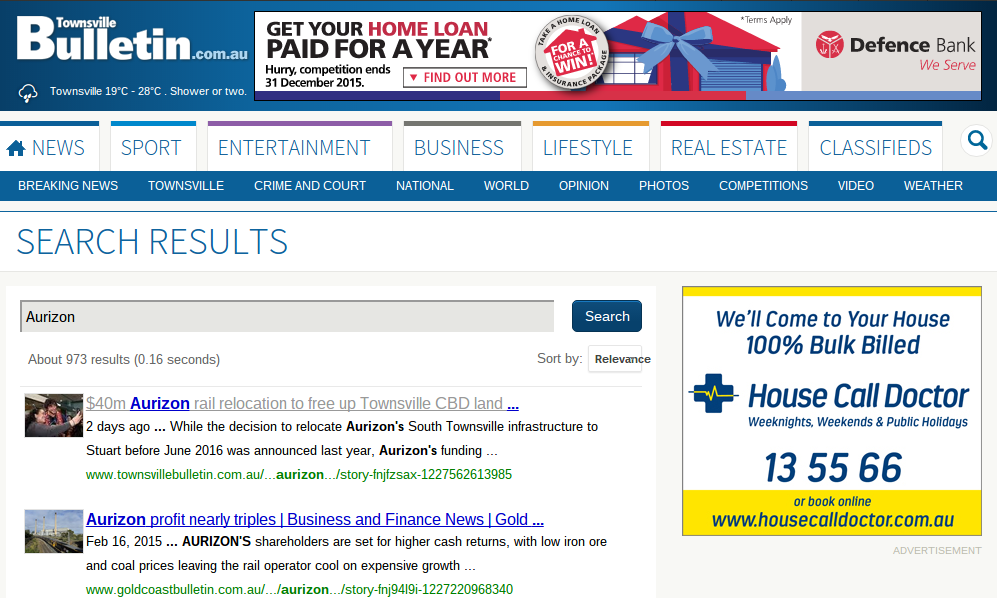
Request to the Townsville Bulletin, please report on Aurizon job cuts for Townsville and Rockhampton

Dear editorial staff at the Townsville Bulletin

Please report on the future job cuts recently announced by Aurizon. On 7 Oct, 2015 ABC Online, and various other major regional  news media outlets ran stories explaining that rail group Aurizon will be cutting 74 jobs from its Rockhampton and Townsville maintenance facilities - 34 of them coming from Townsville. Consultation is to begin by the end of the month with the actual job cuts being processed over the next three years. Verifying with a search on the Bulletin website has confirmed that no story has been published and this is a concern.

A search on the Bulletin website for "Aurizon" did not yield any of the grim, but absolutely important, job-cut news broken by other news outlets. 

The reason for the job cuts have to do with a “touch economic environment for Aurizon’s customers…The changes are part of the Company's ongoing transformation program, announced in mid-2013, to reduce costs, improve operational efficiency and to focus for customers on the core business of rail freight.” Beyond Townsville and Rockhampton, Sydney Morning Herald reports that Aurizon is cutting more than 800 jobs across all divisions as part of $380m in savings needed to curb slumping resources demand world wide.

As the leading source for journalism in the Townsville region, your publication has a responsibility to the people of Townsville to provide important information they need to better assist and run their daily lives. The reality that Aurizon, a rail group integral to the Townsville’s economic strength historically, is facing tough economic times and are responding with cost-savings in the form of job cuts is news the local community needs to be made aware of - especially those involved in rail, shipping and resources industries.

This news is especially significant given that there may be confusion around the performance of Aurizon as well as Townsville as a whole economically. Recently, the Bulletin reported on the $40m Aurizon rail allocation to from the CBD to Stuart, describing the story as a positive boost for Townsville. While there is little argument against the positive outlook this move has for the city, without also reporting Aurizon’s announced job cuts in the local community, there could be confusion over the job security for Aurizon workers.

As a duty to keep your audience adequately informed about issue that are important to them, if steps are not already taken, please begin producing content on this information for Bulletin readers. The people need to know, or be reminded, that on balance, the resources sector is in decline and is expected to be for quite some time, and that a major employer in Townsville is responding by letting workers go.

Thank you


16 November 2014

Primal Living Part 5 - A typical week in exercise

Last week I provided  simple and accurate overview of what a typical week looks like for me in regards to food. In particular, the focus was on how and what I eat according to the Primal Lifestyle. As discussed at the very beginning, while nutrition is the vast majority (80%) of achieving and maintaining optimal health, there is still another 20% to account for - that portion being exercise. Now, 80:20 right away may seem counterintuitive in today's world. As important as living an active lifestyle is, modern advances in technology, leisure and work have lead to generations of increasingly sedentary lives. Once upon a time, people had to grow their own food, perform their own housework and entertain themselves. Today much of our routine involves tools, gadgets and media that automate or provide for us these actions, resulting in much less need to move.

274lb in 2007; 199lb by 2008; 185lb since 2009
In a roundabout way, perhaps this is why there is such an emphasis on time-consuming, unfun and strenuous physical activity. We spend so much time not moving that there may be some inherent guilt about how little physical activity we get and therefore convince ourselves that in order to offset this, we must subject ourselves to long and grueling workout sessions we don't enjoy. We all know these people, or may be one of them ourselves. We wake up an hour before we have to so we can drag ourselves to the gym or pound the pavement for 45 minutes we don't enjoy.

21 Day Challenge Infographic - for the whole graphic, click here
Before I go any further, if you do enjoy this. If you can wake up naturally before first light, instantly feel energised and exhilarated during your 7km run or 40 minute elliptical session, good on you. This article isn't for you. If you truly love exercise to the point where the more of it you can do the happier you are, that's amazing. There are many people however that don't. They may feel proud of themselves for having finished their workouts, but dread the time, energy and inconvenience of spending 4+ hours every week doing something they don't enjoy. Primal is for them. Primal establishes the most efficient ways to workout to achieve optimal long-term sustainable health with as little pain, effort and time possible. For more of a general background on how to excersise primally, you may want to go back to Primal Living Part 1, from  a few weeks back. This week's piece is mostly an example of what exercise looks like for me.

Move frequently at a low pace

The core of my exercise is to "move frequently at a slow pace". For me, this means walking. I walk as much and as often as is practical from a day to day basis. I live about 1km from my workplace, which results in a 15-20 minutes of walking each day. Being a highschool teacher does include a fair amount of walking as well. It's not the most active of professions (I'm not a HPE), but there is a fair bit of travelling from room to room, building to building and up and down stairs several times throughout the day. By the time work is finished, I usually get around 5,000 steps.

Yard work, parking further from the entry to a shop, taking the dog out, it all counts. 
Outside of work, I make sure to walk more throughout the evening. We have an above average sized yard so simply hand watering the plants, playing with the best dog in the world, or just doing light work can add up to a fair bit. Even staying on top of housework, such as washing, cleaning and tidying, serves as a productive way to increase activity. The key is to move. It doesn't matter that you're heartrate's not pumping, or you're not sweating (these things can help), but the most important thing is to move. Remember that one of the biggest obstacles of modern living is how automated the world has become. Once upon a time, there was just more work to do around the house and all of it required more physical activity. I've really come to appreciate the benefits of housework. hand-watering plants, trimming shrubs, mowing and raking are all incredible ways to improve your health if done regularly and frequently, and of course it's productive.

Once in a while, sprint

Once or twice a week I make sure to turn things up slightly. I do love running. I find it meditative and relaxing. A good 20-30 minute run every now and then really invigorates me. I am aware though, that I don't need to run anywhere beyond the point of enjoyment. In the past, running was my primary form of fitness. I did love it, but at increasing frequency, the enjoyment started to dwindle. Setting strict goals and benchmarks of 20, 40, 50kms a week started to tax on my time, not to mention my knees. The truth is, if I didn't genuinely enjoy running, I would stop and I wouldn't be sacrificing my health in any way. In fact, it would be easy to argue that unenjoyable, pain-pushing monotonous medium-intensity prolonged sessions of "Chronic Cardio" actually do more harm than good.

Running as fast as you can, and then walking to rest
What this means is that I limit my running to 3 times a week and usually just go once. I love a good 10km session. I get some of the best thinking I ever do during this hour and feel invigorated afterward. The truth, however is that I am finding it more stale and am now enjoying the variability in mixing it up. This week, I went on two trailruns involving some Hill climbs. Rather than road running, hilly trails include a strong mix of carefully and slowly walking down rocky paths and sprinting as fast as I could for 20 to 30 seconds whenever there was a relatively safe looking incline or set of stairs. Intervals making of various intensities is key. Even though Saturdays hike was over an hour, I only travelled 5kms which means a lot of it was walking. I definitely stopped to rest a few times as well with absolutely no guilt.

4km in 30 minutes is pretty slow, but the terrain offers all kinds of new and engaging challenges
It's taking a while for me to be OK with walking from time to time - being able to maintain a steady pace for as long as possible was always a goal of mine as a runner. However, running at faster speeds, often as fast as I can, with short rests in between has proven to be a challenge in its own right, perhaps moreso.

The view at the top is fantastic 
Lift heavy things

Two or three times a week I make sure I do something that involves lifting heavy things. Most of the time, these workouts involve bodyweight exercises. I hate weight lifting. It's purely a personal thing, but I just don't enjoy working with dumbells, barbells, kettles, heavy plates or big machines. I don't like keeping much equipment in the house (although I do own a few dumbells ranging from 5 to 10 kg), and I really don't like being in the gym. So for me, pushups, situps, squats, pullups and the dozens of variations of these exercises work best.

Pushups, squats, situps... and pullups sometimes. 
At the moment, I'm using the Runtastic suite of fitness apps for most of these workouts. two or three times a week, I go through a pushup, situp and squat workout. The apps are great. They basically organise pyramid style sets and use phone sensors to judge when you've completed the amount of reps. Each workout increases reps or sets each day. At the moment I'm approximately doing 60 pushups, situps and squats each session. It's the simplest of workouts but is definitely challenging.

Handwatering and raking leaves is a simple way increase activity. 
Also, I again try to incorporate housework into my LHT routines. Having a very old property with a lot of landscaping work needed helps, so I find myself digging, planting, levelling, and chopping a fair bit around our house. Try swinging a mattock 50 times to break up dry earth, moving cracked foundation around or chopping up branches and see how much your glutes, back, shoulders, heart and lungs feel it the next day.

Play

Not enjoying exercise is one of the major obstacles people have with traditional workout plans. The fact that so many people in the gym, or running in the mornings need headphones - whether they are aware of it or not, they need to distract themselves from what they're doing because at the end of the day, they're not having fun. This is why play is such an important part of the Primal lifestyle. Find a game or a sport you enjoy. For me it's basketball once every couple of weeks if a game is available. For you it may be golf, swimming, hiking, soccer, softball or simply running around with your children or playing with your dog.

29 minutes of running and 22 minutes of walking doesn't sound nearly as fun as "Basketball" 
One hour of basketball, which includes the light shootarounds with my friends as we warm up and organise the game, covered about 4km of distance travelled, 5000 steps and involved all sorts of physical movements requiring balance, explosiveness, strength and agility. It doesn't have to be competitive, it just has to be something that forces you to run, jump, push, shoot, throw, catch or kick your way to a good time. Whether it's social, or a time to let off steam, there are plenty of ways to find active and fun ways to play - especially with kids, siblings or buddies around.

In sum

So, at the end of the week, my "workout plan" resembles something like:

1. Walking as much and as often as I can. The more the better.
2. Running as fast as I can a few times, maybe 6-10 times, for around 20 seconds each time, about twice a week. This week I did this during a 5km hike up a 300m hill, and again on a 4km trail run of slightly lower of an incline.
3. I had two pushup, squat and situp Runtastic sessions.
4. I played fullcourt basketball for almost an hour.

Not counting the walking, because that is integrated into every day life, the total time I spent explicitly exercising by running, hiking, and playing basketball was approximately 2.5 hours. This is far less than I would spend "training" back when I was concerned with completing half-marathons and thought running 30km a week was necessary for good health. I know plenty of people that spend an hour, to 90 minutes in the gym 4 or 5 times a week because they believe they have to in order to maintain their weight, shape, or stave off heart-disease. If you're a competitive athlete, or want to cross "finishing a marathon" off your bucketlist, that's different. I'm talking about exercising in the most efficient way possible to maintain optimal health and do so in as little time as possible. Having extra time is something pretty much everyone wishes were possible. If you're a sufferer of "chronic cardio", Primal exercise may be your answer.

Exercise doesn't have to be boring, time-consuming or painful 
Well, that just about covers my simple explanation of Primal Living. What began as a single piece explaining what the Primal Blueprint is and breaking down the grave misunderstandings of optimal health and the causes of increasing obesity, diabetes, heart-disease and deteriorating brain health over the last century, turned into 5 weeks of discussion and reflection.

I would love to continue writing about this, but the truth of the matter is I don't have the expertise required for any more depth. In a few weeks, I plan on enrolling in the Primal Blueprint Expert Certification Course, which through focused study will grant me with the knowledge and understanding needed to really implement, promote and educate on Ancestral Health, but that's looking into the future.

For now, just remember that everything we've been taught about modern western diet is rubbish. We don't need carbohydrates. Fats are important. There's nothig wrong with meat. Avoid sugar as much as possible. Eat as many fresh colourful vegetables as you can handle. Exercise doesn't need doesn't to be painful, boring or time-consuming. I've provided the basics from a very casual, testimonial perspective, but for any of the details or science behind Primal living, there are a tonne of resources at Marks Daily Apple. I also strongly recommend The Primal Blueprint by +Mark Sisson. Clearly, this book (Amazon, or Google Play, ) has changed my life and believe everyone would benefit from living according to its principles. 

Marks Daily Apple 
Thanks for reading, let me know what you think in the comments, and please spread the word.
If you want to jump back to any of the earlier parts of this Primal Living Series, I've included the links below.

26 October 2014

Primal Living Part 2 - Ancestral health in the modern world

Last week in Part 1, we introduced the key principals of the Primal Lifestyle -- namely, what to eat and how to exercise. This week, it may serve helpful to discuss some of the background of the Primal Blueprint and where it fits in with life in the 21st century. In doing so, we examine the analogy of "Ancestral Health" by which we mean, emulating the habits of our ancestors whom existed for thousands of years without any of the "lifestyle diseases" plaguing us today. The goal is to understand how to adopt these principals and live primal in the sedentary, highly processed, over-worked world the majority of us live in . 

Ancestral Health

A common misconception about wanting to live like our paleolithic counterparts is that it's about actually turning back time. It's not. Being paleo or primal isn't about camping in your backyard, producing all of your own food, or hunting stray animals. The idea is to use what we know about evolutionary biology through the use of modern science and marry it with the principles and concepts of our ancestors that evolved and lived in optimal physical condition for hundreds of thousands of years. Now, I've explained this to a few friends and the usual question is “isn’t life expectancy much longer now than it was for cavemen?” While the logic behind this question may be understandable, it's still misguided. Yes today, odds are, we will live pretty long lives - much longer than people did 5000 years ago. However, this is because we don’t have to worry about dying from the flu, an infected cut or the shock of a broken limb, not because we are more physically fit and healthy. Plus, we don’t have to worry about being attacked by bears, hyenas, snakes or crocodiles as much as we once had to. What we do have to worry about is obesity, heart-attacks, Alzheimer's disease  and strokes.

Our declining health is absolutely the most important wide spread societal problem there is. Public health care budgets are ballooning so much that it's becoming general consensus that in 30 years such support will cease to exist. Billions of public and private dollars are funneled to providing health care. What makes this worse is that all of these leading conditions creating this drain on facilities, professionals and resources are generally agreed upon to be preventable. The problem is that most people have just been given the wrong information. Fat-free, carbohydrate rich foods do not make up a healthy diet.  The truth of the matter is, outside of the last 300 years, the modern western diet wasn't even possible for our species to survive on - let alone thrive on.
Sugary foods at the base of the pyramid? Crackers healthier than Broccoli? This is crazy. 
The reality is that our ancestors simply didn’t regularly  have the carbohydrate heavy foods that have become the basis of the modern western diet. Rice, bread, corn syrup, pasta, sugar and fruit weren’t routinely eaten because they were incredibly difficult to gather and produce (impossible in some cases depending on the region). Animal meat and fresh vegetables were the staple foods that have sustained humans for hundreds of thousands of years. Fruits were seasonal, in tall, difficult to access trees  and competed for with more nimble animals and thus only available in relatively small amounts. Even honey was protected by bees. Where today we can have something sugary sweet whenever we want in large amounts, foods full of glucose and fructose were a rare treat for our primal brethren. Nevertheless, thanks to a combination of poor science, selfish economics and shortsighted governance, we have the USDA approved Food Pyramid above. Odds are, anyone who went to school after the 1960s learned this as the key to a healthy diet. I bet I didn't even need to include the image, everyone knows it. How could we have been so wrong? Not only is it backwards in term of carbohydrates, but look at those tiny little white triangles representing sugar. How on earth can the foundation of a healthy diet include sugar? If you want to refresh your memory, click here to see the Primal food pyramid. The one that is actually good for you. 
Eat less carbs, be more healthy. This is the most important rule people need to know.
This chart shows the simple relationship between the bodies natural ability to burn fat efficiently, which is what we all want and need to be able to do in order to maintain good health. It also shows the disruption carbohydrates do. Generally, and if we're speaking entirely of weight control, there is a range between 100 and 150g of carbohydrates per day that the average person can eat without gaining any weight. Any more than 150g and you enter the "Insidious Weight Gain" zone. Here, your carb intake is high enough that your body looks to them for all energy conversion rather than fat. If you train hard enough (60 minutes of intense daily workouts), then you can offset the insulin boost. If not however, any carbs not used are converted to fat and packed away, leaving a trail of sugar behind. 

Most of us aren't performance athletes
If you love it, go ahead and train like a marathon runner, but if your goals are just to look and feel good, and fight off disease, it shouldn't be that difficult. 
The reality is that food and activity are the cornerstones of any approach to improve health and the Primal way is no different. What is unique, is the principles of what you eat and why, and the significance this has on overall health. It’s a common belief that living healthy is mostly based on what you eat relative to how much you exercise. Most diets and workout plans will say this. Primal Living uses a ratio of about 80:20. Why is it then, that so many people spend 45 minutes to 2 hours of painful, boring and expensive time exercising on most days just to be healthy? Is that really necessary? If you’re a competitive soccer player or triathlete, all the power to you, it’s commendable that you have a passion and are so dedicated to it. Most of us don't have that passion. Most of us just want to feel better, look good , and reduce our chances of having a stroke while we still have a mortgage. 

Another big benefit with Primal is that I can miss workouts pretty regularly without feeling any effects. Sick, tired, busy or just not feeling like it isn't a detriment to my weight, energy levels or performance. 
Besides, this is isn’t about the triathletes. This is about the everyday worker that has a family history of heart-disease and wants to be able to play with their grandchildren. Why do they need a a carb-boost every 3 hours? Just so they can workout every afternoon? Or, do they work out every afternoon so that they can eat that jam bagel every morning and bowl of pasta every night? Is the point of eating and working out to ensure that we can and need to do both, or is the point of both to live a healthy life that satisfies us? Personally, I know I'm pretty lazy. Whether it's because of work, entertainment, leisure or rest -  I don't want to have to spend 1 hour a day exercising just to be healthy. I also don't want to feel like a failure and put on weight if something happens and I can't work out for a few days or weeks. It shouldn't be that hard and it doesn't have to be. 

Next week, I will discuss some of the similarities and differences between the other noteworthy high-protein/low-carb diets - Paleo and Atkins. I will also  try providing some insight into my personal habits and daily routines for those that may want a practical, real-world picture of an average person and how they go about maintaining their health long-term without trying very hard.

For any more information, or the scientific research behind any of this, head to MarksDailyApple as a starting point. On that note, just so we’re clear, this is heavily backed by current and increasing bodies of academic research based on health, nutrition and evolutionary biology. What I’ve tried to do is provide a very simple, layman's description of what this all entails.

28 September 2014

Very Well Designed - Bellroy Slim Sleeve Wallet


Bellroy is a company that takes a refreshing amount of care in making wallets. As unusual as it may be, this Australian brand takes great care in to reduce the size of the modern wallet in pursuit of more practical, comfortable and stylish minimalist design. Here is how they describe themselves on their about us page:
Bellroy exists to slim your wallet.
But just slim isn’t enough. We want our products to look elegant, be functional yet delightful to use, and offer a surplus in value.
With a narrow focus, constant learning, agile processes and creative thinking, we can continually improve the solutions and insights we share. If we do this well, you'll be able to move between work and play, having your pocket contents adapt along with you.
Our efforts should also be respectful to all stakeholders in the business and friendly to the environment. If that sounds kinda interesting, jump in to our community, join in some of the conversation, and perhaps even become a part of this evolving group that is Bellroy.
If personality and imagery are important to you when looking at brands, +Bellroy  deserves a lot of respect. They've nailed it. Everything from their website design to their product packaging shows a very creative and deliberate attention to detail. Of course, what matters most, is the quality of the product. This is a review of Bellroy's Slim Sleeve every day wallet.


I've had mine for about six weeks and am incredibly pleased with it. The premium cow leather is thin, but feel strong and of high quality. The colouring is smooth and consistent. I prefer natural tones with leather products so any fading would add character rather than show degradation, but I haven't really experienced any. Although the normal signs of use - dirt and colours from pants pockets, are starting to show, the vegetable dye itself is still very much in tact.


The beauty in the Slim Sleeve, and all Bellroys apparently, is in the design. These wallets are engineered from a single piece of leather which, when folded and stitched smartly, makes for a much more durable construction in a less wasteful and more compact finished product. The image above show all of the materials involved in making the Slim Sleeve and quick animation of what they call the nude approach can be found here.


The intelligence in this design is appreciated immediately. Coming from typical department store bifold wallets, I was instnaly amazed at how much smaller, lighter and more premium this wallet was. The style elements are noted only by the stitching and small pressed branding on the outside corner. As understated as it seems, the look is still incredibly distinct. The a simple bifold with cards stored in portrait rather than landscape and the two quick access slots in the inside instantly had me wondering why all wallets weren't designed in this way and what the point was of having any more than one or two individual card slots. As you can see, there are spaces to quickly access your two most frequently used cards, in this case, my two credit cards. All of my other cards can easily go weeks without ever needing to be pulled out. 


These necessary but unused cards stack and fit inside the two inner sleeves. The one on the right is expanded to hold the majority of cards, I have six there. That grey tongue you can see is a pull tab to make accessing these cards easier, relieving you of having to dig them out with your fingers. I'm not entirely sure how necessary this is, it's not that difficult to get them out, but it does add a design element which I really love. Also, I'm sure grasping them without it might stress the leather a bit. 


As far as numbers go, my full wallet, with everything I need to carry (and nothing more) measures about 1.5cm thick. To put this in perspective, this is thinner than the old wallet it has replaced when empty. Looking at the full Bellroy and the empty old one side by side leads me to shake my head at how wasteful and excessive we can be with our resources as a result of poor product design. 


Officially, the Slim Sleeve is meant to old between 4 and 14 cards and a few notes, bills or receipts. I've never really carried coins with me regularly, and in the odd circumstance where I need some change, my pocket it fine. I always have 2 bank cards, 2 credit cards, my driver's licence, my medicare card, my private health coverage, a grocery store loyalty card, my organ donor card, work ID,  and my automotive assistance card. Not all 11 of these are essential, but they do cover both emergency and convenience situations and I've never had any trouble slotting in a few receipts or folded bills if need be. 


I should mention that this isn't the only option +Bellroy makes, they have larger variation to account for passports, coins, and hidden compartments as well, depending on your needs. Believe it or not, but there are two styles that are even slimmer - the Card Sleeve and the Very Small which are essentially single sleeves for all cards or notes to be stacked together. For me, the Slim Sleeve hit the perfect balance between form and function. I do love the aforementioned quick access slots, and I just really like the look of a good bifold which closes everything up from prying eyes. If there's one thing I don't like, it's a wallet which exposes everything inside, which is why money clips and phone wallets will never be for me.

As time passes, one thing that can be said about people in this day and age is that mobility is becoming increasingly important. Whether it's for travel or everyday commuting, the desire to comfortably carry is becoming ingrained in modern culture. As far as function and practicality are concerned, there are few items that are more important than a wallet. There is also a higher standard we hold our companies to socially. In a world that is becoming increasingly shared and transparent, +Bellroy understands that we expect our companies not just to make quality products but to also do so in a distinguishable, responsible and thoughtful manner.

For more information on +Bellroy head to bellroy.com  and to check out their great blog +Carryology  which presents brilliant deisgners "exploring better ways to carry" click here


25 September 2014

Holiday Housework - Painting and Gardening


This week I started a couple weeks of holidays, and with all breaks, the priority is house work. Job number one was to repaint our front steps since as you can see, they finishing needs a fair bit of work. We were never after a big renovation, we just needed a bit of weatherproofing. The months from January to March are about as heavy as anywhere in the world in terms of rainfall. The steps were freshly painted when we moved in a year ago, and we didn't like the idea of hoping they would hold up after what has happened to them after just one year.


Cleaning, scraping and sanding the stairs took around 3 hours of my Sunday. This was my first time painting anything on the exterior so I am not entirely sure if I picked off enough paint. I didn't really feel like spending money on a power sander, so I did everything by hand. I am generally content with how much effort I was putting into everything. I made sure everything was smooth to the touch and splintering was reduced as much as possible. The first coat went on on Monday and the second coat on Tuesday. It's Thursday as write this and we've just started walking on it a few hours ago. It rained a little bit the other day so the fingers are crossed it dried properly.


On a bit of impulse, we walked into the store planning on just going with the basic dark brown, we figured, now is the perfect time to experiment with some of our colour ideas. If it works well, great, but if not, there was a good chance the stairs would eventually get scrapped within a few years anyway. We went with Colorbond Ironstone (Chip no T147) by Cabot's Timbercolour. The shop worker recommended it as the most durable and easiest to work with. I don't have anything to compare it to other than the British Paints we used to paint our bathroom white.


I'm not an expert when it comes to house painting but I do have some experience. I've done interior drywall a few times painting my room as a kid, and I've painted the aforementioned bathroom. This being said, I don't know how to apply painter's tape. I always end up having to retouch. 


After two coats, we're more than happy with how it looks. We'll see how it holds up after this summer (we average over 1000mm of rain from Nov to Feb with 35C temperatures), but as it stands we really like it. Although I read and watched a lot of how-to's, this article in +SFGate  by +Kristy Robinson seemed to be the one I referred to the most.

We plan on making some major renovations and extensions to the house over the next 5 years so there's a good chance the steps could get scrapped, or at least redone sometime in that term. In any case, I was looking forward to this as an opportunity learn a little bit about exterior timber restoration. We're still in the drawing stages, but I'm sure a deck will be part the aforementioned renovations.


Tending to the garden was second on the list of priorities. Having these two projects to focus on in tandem worked quite well. You wouldn't tell from the photo, but I really like gardening. I am really enjoying revitalising our yard, which was in fairly bad shape when we moved in. There's a lot of laborious work in lawn repair (turfing, weeding, levelling, etc.) so we made sure to have one aesthetically pleasing garden to care for in the meantime.


After turning over the soil and pulling the weeds we moved the bulbs to the edges and planted a few begonia, ixora and hibiscus bushes. I am hoping we are not foolish for not laying down weedmat or spraying any sort of weed killer. Some have told us it's a necessity, others have assured us they've never used it. Live and learn. In terms of design, a less organised arrangement seems to work best with the vibe of our yard. Also, it's easier. It seems a little bare, but I'm counting on the shrubs to fill out. One thing's for certain, I love the smell and look of  the tea tree mulch the nursery recommended. We shall see.

One year into owning our fixer-upper and I'm learning that really the only way to learn is by trying and hoping for the best. We're loving chipping away at all of the jobs this old house keeps presenting to us. It's the end of day 6 and the two main tasks are complete. I still have 12 days left to my holiday, and although nothing is planned, I'm sure the house will give me something to do. Abraham Maslow said, "if the only tool you have is a hammer, (it is tempting to) treat everything as if it were a nail". I'm sure the law of the instrument still applies with a paint brush.


01 September 2014

This is How I Work

Many people are aware of +Lifehacker, the "how to get things done and do everything better" expert guide. Like most, I've grown accustomed to tips, reviews, advice and stories I frequently add to my personal and professional practice. 

For years, one of my favourites of theirs is an ongoing series entitled "How I Work." These stories are personal testimonies of notable involved in tech, business, art, design, or any other walk of life requiring creativity, organisation, productivity and success. 

Figure 1: A very big thank you to the people behind Lifehacker. I owe a lot of what I do to your expertise. 
Inspired by these stories, I've spent years consciously fine tuning my repertoires regarding how I store files, organise deadlines and appointments, track progress on ongoing tasks as well as prioritise everything involved in my particular job (high school teacher). The result, is what I believe is a clean and efficient set of work routines centred around simplicity, convenience and comfort. So, as if I was someone noteworthy, this is how I work. 


Like anyone born after 1980, computers drive me. Many criticise the modern lifer's reliance on technology by questioning the strength and development of the brain. This makes complete sense. I'm sure most people can recall numerous cases where someone (perhaps themselves) is unable to perform a task without technology they should be completely capable of doing themselves. Every so often there are reports that younger people are losing basic developmental skills because of this - literacy, numeracy and simple motor skills are typical examples. I don't think it's an exaggeration to suggest that spelling, arithmetic calculations and penmanship are deteriorating for the average person as time goes on. That being said, technology is here and our world is built upon it - rolling back the clock to retain the skills students of the 1970s had is not the topic of this reflection. 
Whether or not technology is weakening my intellect aside, one thing I'll defend whle heartedly is that it definitely reduces a lot of its work load. If you've have read consultant and executive coach David Allan's "How to Get Things Done: The Art of Stress-Free Productivity" you will understand much of the framework how I work is based on.


Figure 2: Everyone has a few things they've learned that stay with them forever. One of mine is "Mind like water".
As said above, my mantra is increasingly becoming based on simplicity, convenience and comfort. This means that whenever I'm taking on new tasks or preparing for big jobs, figuring out how to ensure it gets done effectively with the least disruption, highest success rate and minimal effort is paramount. Mind like water is loosely, the ability to remove all menial, simple thoughts from the brain by setting up a robust, stable and easy system of reminders. The goal is to allow your mind to focus on the more important work problems (i.e., how to engage the under-achieving students or master that new piece of complicated, high-end equipment) because it's no longer preoccupied with the more frivolous (i.e., remembering to photocopy those documents or what time that meeting next week was). 

What this culminates in are three areas of organisation and productivity -- organising my digital content, organising my physical content, and a comfortable work space to create and manage everything in.

Google is by far the most useful resource on the internet for me. Where many associate it purely for search, I have integrated almost all of my organisational and communication workings around its services. Gmail, Calendar, Keep, and Drive are mainstays with me. The synchronisation across these services as well as with the rest of Google makes so many things I need to do on a day-to-day basis incredibly easy and reliable.The key to my system is both accessibility and ubiquity.  Almost every job, appointment or deadline is recorded, sorted and searchable, usually with appropriate reminder notifications on my phone or email. I absolutely love that I can be out and about and need to jot down a quick note or record an appointment and whether it's via my Nexus 4 Phone, Asus Zenbook Windows Laptop, or a friend's iMac, if I have an internet connection, that thought is getting filed away in an organised and easily accessible space I am sure to see when I need to. Getting Things Done is to establish a system of these reminders in a way that enables me to trust this system and free up my thoughts and focus for more heuristic challenges. It took a bit of deliberate dedication, but now when I get reminded a month in advanced that my local council rates and electricity bills are coming up, I'm grateful because I know I have time to prepare. I'm also aware of how frustrated I would be if  $2000 worth of bills showed up in my mail box and I didn't see it coming ahead of time.

Figure 3: The majority of items in my calendar I remember, but there's still many I forget. Most of them are important, a lot of them aren't. The important thing is that none of this matters. Everything gets listed and I see everything coming. 
Despite my affinity for technology, a lot of the information worth keeping is (at least originally) printed on paper. Receipts, contracts, invoices, bills, tax statements, academic records, reference letters, product warranties, legal and financial documents and the countless other types of forms and records all need to be kept somewhere with the emphasis on the word kept. Late Carnegie Mellon Lecturer and Disney Imagineer Randy Pausch spoke of the importance of having some filing system -- even if it's just based on alphabetical order, in his famous Last Lecture. Thankfully it hasn't happened to me personally yet, but I do know people that went through a time where they needed to produce some document that was several years old and couldn't, and as a result, paid a very high cost.
Figure 4: In short, Randy Pausch died of pancreatic cancer in 2008, but before he did, he gave one final lesson on how to truly make the most of life. The book documenting preparations for the lecture (above) and lecture itself entitled, "Really Achieving Your Childhood Dreams" (below) have changed my life about as much as any book or lecture possibly could. 
It's not the most thorough filing system, but it fits my criteria of simplicity, convenience and comfort. My first experiment was with hanging drawers and cabinets, but these were too bulky and seemed to attract more clutter than anything else. I also didn't like how immobile they were so back to the op-shop they went. Accordion folder's were the next attempt, I thought organising everything by time (month and year) was the best way to do it, they were mobile, had any compartments and easily storable. However, the problem with them was that sorting though and recovering documents took too much time and required me to remember which month they were received in. The system continued to progress to where it is now. I have large (8 cm or 400 sheet) binders loaded with plastic sleeves. The binders each represent a financial year and the plastic sleeves each hold a series of documents (i.e., one sleeve for all energy bills that year, one for all work receipts, etc). This seems to cover everything I want out of a filing system. It's mobile (if I'm meeting the accountant I have everything in one fixed portable package), it's flexible (I can move last year's insurance statements to this year's folder purely if I decide I want them all in one place), and it's easy to manage (flipping through everything is much easier than pulling individual files out of folders or compartments). I have yet to organise where to keep everything as the financial years tick over, but a shelf seems like a logical next step and for now, this works perfectly.
Figure 5: Smart adulthood 101: Commit to a filing system that easy to manage
The last arena of how I work may be both the least and most important of the three simultaneously. Having a fixed workspace in this day and age seems to be becoming less applicable to modern work-life thanks to mobile computers. Whether it's as a student, or a professional, there's isn't much literal reason a desk is any more valuable than a kitchen table, coffee shop, bed or couch regarding most non-tradesman work these days. Emails can be sent, spreadsheets filled out, documents read and reports written, all just about anywhere thanks to today's technology. This, coupled with the ever-increasing erosion of the typical 9-to-5 work day, leads me to very easily imagine a world where a large desk like mine has more to do with aesthetics than productivity.
Figure 6: "Off-Mode"
This desk, like everything else I've rambled on about in this piece is the product of years of adjustments as my preferences, organisational needs, and standards of work have evolved. Test, evaluate, modify, repeat, forever. This is an important theme I try to apply to just about everything I do. As far as my workspace is concerned, this has lead me to develop three clear priorities. The first is space. A big space paramount. I often find myself using multiple documents, texts, or resources at the same time. It's much easier to do if I have the space to sprawl them out and still have the ability to write, draw, read or type comfortably. It should be clear from the photos how highly I value a large workspace, whether it be physical desk space or a large monitor. As you can see from Figure 6 there is abundance of space. It's not a massive executive's desk, but it's definitely not the typical dorm-room piece either. The binder files I noted earlier, 32 inch TV I use as a monitor, a keyboard, mouse, pen cup, pin board, lamp, oh-so-important plastic sleeves, fan, a jar of fake flowers, a notebook, 6 point individually switched power bar and laptop all fit neatly in their spaces and still leave a very generous amount of desk real estate available.
Figure 7: "On-Mode"
I'm no programmer, web developer, designer or artist of any kind, but a dual monitor set up  make things so much easier. I don't have the means to set one up at work, but for my home workspace, this is compulsory.
Figure 8: Have a seat. 
With comfort, you also need a quality chair. Ours may not be the prettiest, but it's definitely comfrotable. Plus, the aesthetics improved a fair bit by me reupholstering the armrests. That's right, butterflies. I chose that fabric. It matches a cushion and ottoman we have in the same room. 

Figure 9: Particle board, vinyl and plastic -- $50 well spent at a local op-shop.
I'm not entirely a fan of all of those cords on the right hand side, but between my wife and I sharing the desk (and swapping laptops from time to time) there's a pretty consistent pattern of plugging and unplugging going on. Also, in efforts to reduce our electricity usage, we like being able to switch whatever isn't being used completely off, hence the white labels on most of the cords.
Figure 10: I care an awful lot about space management
Simplicity, convenience and comfort have become the three criteria I apply to almost everything. With all of these comes space management. One of my two most recent "a-ha! moments" (as Oprah calls them) is the pinboard. This used to be a white/dry-erase board which was always filled with lists, reminders and motivational quotes. For a long time I loved the convenient way of jotting notes down on a highly visible platform, however, I eventually realised it was mostly filled with jargon that wasn't really all that important - plus it was dirty and required regular cleaning. An old pinboard being thrown out at work, some varnish and white paint and I have something that I feel improves upon my workspace needs. As mentioned before, technology allows me to easily write notes down, so a whiteboard isn't exactly necessary. Writing on paper ensures that only things that truly need to be in front of my face get pinned up. Also, pins have a subtle yet crucial second function. You can hang things off them. I've tried cups, bowls, and hooks in various places around my house, but pins on this pinboard on my desk is the first place I've actually been able to consistently keep my keys. I haven't had to look for my keys in weeks!

The second "a-ha" came when wanting to keep those binders on my desk, but refusing to get rid of the fan. For a while, the fan sat on the desk while the binders lived on a shelf on the other corner of the room. It's only a few steps, but it really would be better if I they were right there within an arm's reach. I then decided to try using one of those cheap straw storage boxes that are everywhere these days to put it on it's side. It worked perfectly. The binders are stable without the need for bookends and the fan fits perfectly on the makeshift shelf. We're planning renovations to our home, so building a shelf, or buying any new furniture is not something we're ready for at this stage. This sideways box-shelf  changed everything and is one of the best ideas I've ever had but isn't exactly the other "a-ha! moment" I was referring to. It was the laptop. The box-shelf gave me a fantastic home for my laptop when it's not in use .

You may have already noticed it, but if not, look again, you'll spot it.

P.S. For the record, I spent almost an hour trying to figure out why the formatting of this (fonts, sizes, alignments, colours) are all messed up and gave up. I know it may be ironic, but as I said, I'm no programmer.